

Pretend I'm the Princess: Assessing and Treating the Language and Pretend Play

Presenter Course Action
Presenter: susan hendler lederer
Susan Hendler Lederer
“Pretend I'm the Princess”: Pretend Play Theory, Assessment, and Intervention
CEUs/Hours Offered: ASHA/0.1 Introductory, Professional; CASLPA/1.0
Text Course: #5205 · Duration: 1 hour
Pretend play provides rich developmental opportunities across cognitive, linguistic, and social-emotional domains. In this course, we will explore the development of pretend play from solitary to collaborative; identify developmental relationships; discuss the nature of pretend play in children with language impairments; learn a 10-step protocol for assessing the language of collaborative pretend play; and explore intervention options. A case study will be provided.
Sign Up For Professional or StudentUnion   to get the whole article and handouts.
Sign Up For Professional or StudentUnion to get the whole article and handouts.
Print  

 Communication access realtime translation (cart) is provided in order to facilitate communication accessibility and may not be totally verbatim. The consumer should check with the moderator for any clarifications of the material.

>> Christa Tober:  Good afternoon, everyone.  Welcome to today's e‑Expert Seminar entitled, “Pretend I'm the Princess:  Assessing and Treating the Language and Pretend Play” presented by Susan Hendler Lederer.  Susan is an Associate Professor in the Department of Communication Sciences and Disorders at Adelphi University, Garden City in Long Island, New York.  She is a New York State licensed and nationally certified speech‑language pathologist with 30 years of professional experience in the areas of language, literacy and pretend play development and disorders.  Dr. Lederer has published and presented nationally on best practices in these areas.  In addition, she is the author of three children's books designed to facilitate emerging language, literacy and pretend play.  Welcome, Susan, and thank you so much for sharing your expertise with us today.

>> Dr. Lederer:  Good afternoon, everyone, and thank you for sharing your lunchtime with me.  If you have downloaded the handout, try not to look ahead so that when I ask you some questions you can sort of think about them before you see what I think the answer might be, because you may come up with an answer that's even better.  So let's get started.

Today in the hour that we have, we plan to cover the following topics:

  • We will define pretend play and all the aspects that constitute playing. 
  • We'll discuss the development of pretend play from its earliest years when the children are just pretending all by themselves, to the more sophisticated and elaborate periods in which they're pretending with other children.  I call that collaborative pretend play. 
  • We'll talk about the developmental relationships between pretend play and areas such as language, literature, academics, social and emotional skills and then we'll talk about our kids. 
  • We'll talk about testing.  But our focus is going to be on assessing the language of collaborative pretend play and we'll have a small case study, actually a practicum, where I'll give you some focus questions.  We'll watch a five minute video and then we will see what conclusions we can derive about how well our children are playing
  • And intervention, or what we can do to help advance their pretend play skills. 

How do you know that Zoe and Hammie are pretending?

So if you're a fan of the comics here is my favorite. 
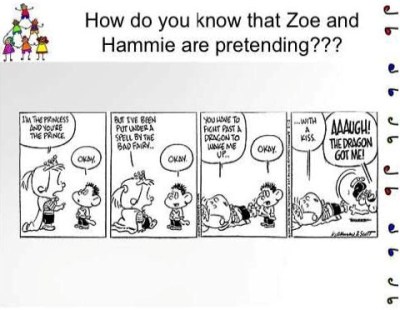
Figure 1

This is Zoe and Hammie from Baby Blues and Zoe says, “I'm the Princess and you're the Prince.”

Hammie says, “Okay.  But I've been put under a spell by the bad ferry.” 

“Okay.”

“You have to fight past a dragon to wake me up…”

“Okay." 

“…with a kiss.”

“Ahhhh!  The dragon got me.”

So here is my question.  How do you know that Zoe and Hammie are pretending?  Take a minute and on your notes just write down a few, maybe two ways, that you can tell that they're pretending.  And when you think you have a good answer, send me a note in the Q‑and‑A box.

Gionna says:  “You be this.  I'll be that.” So the idea of assigning roles is a very important component of identifying that a child is pretending.  And she also says that there are props being used and we can see, for example, that beautiful towel cape and I'm sure a dime store tiara.  Katherine says, “This is an imaginary scenario.” - which is true.  This is the living room probably so it’s not actually a kingdom. Susan says, “She's not really a Princess.”  I'll just do a few more. Dee Anne says that Hammie is reacting to the pretend dragon, which that's really cool.  So the idea that sometimes the object is not even there is an excellent point.  And Grett says something about acting out the story.  So we see we have a sequence of events.  Thanks to all the rest of you who have typed in your answers.

This page is not available, because you are not logged in to your Professional or StudentUnion account.

The rest of this article is not available, because you are not logged in to your Professional or StudentUnion account.

Sign Up For Professional or StudentUnion to get the whole article and handouts.

This page is not available, because you are not logged in to your Professional or StudentUnion account.

This page is not available, because you are not logged in to your Professional or StudentUnion account.

This page is not available, because you are not logged in to your Professional or StudentUnion account.

This page is not available, because you are not logged in to your Professional or StudentUnion account.

This page is not available, because you are not logged in to your Professional or StudentUnion account.

This page is not available, because you are not logged in to your Professional or StudentUnion account.

This page is not available, because you are not logged in to your Professional or StudentUnion account.

This page is not available, because you are not logged in to your Professional or StudentUnion account.


Sign Up For Professional or StudentUnion   to get the whole article and handouts.
Susan Hendler Lederer, Ph.D., CCC-SLP
susan hendler lederer

Susan Hendler Lederer, Ph.D. is an Associate Professor in the Department of Communication Sciences & Disorders at Adelphi University, Garden City, Long Island, NY. She is a NYS licensed and nationally certified Speech-Language Pathologist with 30 years of professional experience in the areas of language, literacy, and pretend play development and disorders. Dr. Lederer has published and presented nationally on best practices in these areas. In addition, she is the author of three children’s books designed to facilitate emerging language, literacy, and pretend play (I Can Say That, I Can Do That, & I Can Play That).

Category:

Related Classes

Presenter Course Action
Presenter: susan hendler lederer
Susan Hendler Lederer
“Pretend I'm the Princess”: Pretend Play Theory, Assessment, and Intervention
CEUs/Hours Offered: ASHA/0.1 Introductory, Professional; CASLPA/1.0
Recorded Course: #5148 · Duration: 1 hour
Pretend play provides rich developmental opportunities across cognitive, linguistic, and social-emotional domains. In this course, we will explore the development of pretend play from solitary to collaborative; identify developmental relationships; discuss the nature of pretend play in children with language impairments; learn a 10-step protocol for assessing the language of collaborative pretend play; and explore intervention options. A case study will be provided.
Presenter: susan hendler lederer
Susan Hendler Lederer
First Words, First Books and Focused Language Stimulation
CEUs/Hours Offered: ASHA/0.1 Introductory, Professional; CASLPA/1.0
Text Course: #3557 · Duration: 1 hour
The purpose of this article is to review principles for choosing early vocabulary targets, document the theoretical and empirical evidence supporting the use of focused stimulation, and discuss the best books to facilitate early target words using focused stimulation. The article concludes with a selected annotated bibliography of recommended storybooks to facilitate one or more early vocabulary targets.
Presenter: susan lederer
Susan Lederer
The First Lexicon: Assessment and Intervention
CEUs/Hours Offered: ASHA/0.2 Introductory, Professional; CASLPA/2.0
Recorded Course: #2897 · Duration: 2 hours
The purposes of this seminar are to review the research on the acquisition of first words and discuss the applications to therapy. Specifically, discussed assessment, target vocabulary selection, choice of therapeutic techniques, and the best materials for facilitating the production of first words.
Presenter: susan hendler lederer
Susan Hendler Lederer
Finding and Facilitating Early Lexical Targets
CEUs/Hours Offered: ASHA/0.1 Introductory, Professional; CASLPA/1.0; IL EITP/1.0
Text Course: #4189 · Duration: 1 hour
The purpose of this course is to provide the reader with the research base necessary to support clinical decision-making in the areas of choosing and facilitating first words. This course will cover development of early lexicons in children developing typically and those with developmental language delays, assessment of first words using parent-report instruments, strategies for choosing targets, evidence-based intervention techniques for facilitating goals, and contexts in which to conduct intervention.
Presenter: pamelazita buschbacher
Pamelazita Buschbacher
The SLPs Role on an Early Childhood PBS Team-Designing and Implementing a Behavior Support Plan
CEUs/Hours Offered: ASHA/0.1 Intermediate, Professional; CASLPA/1.0
Recorded Course: #3938 · Duration: 1 hour
65 - 96% of young children with emotional or behavior problems have moderate to severe language problems (Gallagher, 1999). Since Positive Behavior Support assumes that all behaviors serve a communicative function (unintentional or intentional) a speech-language pathologist can play a vital role on the PBS team. This is the second in a two-part presentation on PBS with a focus on designing and implementing a behavior support plan that is child-centered with the focus on skill-building.