

Constraint Induced Language Therapy for Aphasia

Presenter Course Action
Presenter: anastasia raymer
Anastasia Raymer
Constraint Induced Language Therapy for Aphasia
CEUs/Hours Offered: ASHA/0.1 Intermediate, Professional; CASLPA/1.0
Text Course: #4815 · Duration: 1 hour
In this course, we will review the principles of neuroplasticity that are the foundation for Constraint Induced Language Therapy (CILT) for aphasia. We will then examine evidence for the effects of CILT on measures of language functions and communication activity/participation. Neural correlates of CILT effects revealed in imaging studies will be summarized as well.
Sign Up For Professional or StudentUnion   to get the whole article and handouts.
Sign Up For Professional or StudentUnion to get the whole article and handouts.
Print  

This is text-based course is a written transcript of the course, “Constraint Induced Language Therapy for Aphasia” presented by Anastasia Raymer on February 21, 2011.

This text is being provided in a rough draft format.  Communication Access Real-time Translation (CART) is provided in order to facilitate communication accessibility and may not be a totally verbatim record of the proceedings.

Click Here for Supplemental Handouts

>> Amy: Hi, everybody, let's get started.  Welcome to our e-learning expert seminar “Constraint Induced Language Therapy for Aphasia” at SpeechPathology.com.  Dr. Raymer received her B.S.Ed. from University of Wisconsin-Madison and her M.A. and Ph.D. in Speech Pathology from the University of Florida.  For the past 25 years, her research has examined the neural and cognitive mechanisms implicated in disorders of lexical and praxis processing, and the means to promote optimal rehabilitation of these disorders in individuals with stroke-induced aphasia, dysgraphia, and limb apraxia.  Her work is supported by the NIH (NIDCD) and the Department of Defense.  She has published more than 50 papers and chapters and has presented nationally and internationally.  She is a fellow of the American Speech-Language-Hearing Association and former coordinator of ASHA Special Interest Division Two.  Welcome, Stacie, and thank you for sharing your expertise with us.

 (applause)

>> Stacie: This is going to be different to talk to you all through the computer, but hopefully this works out well and we’ll have a productive hour ahead of us.  We have been talking a lot about Constraint Induced Language Therapy for aphasia.  We really haven't done this particular type of treatment until just recently and we’re doing a study right now.  It has definitely changed my perspective on the treatment.  The way I led into this direction was because of some work I did as a volunteer with ASHA, with some of the ASHA staff, with Leora Cherney, and Janet Patterson, so I'll be referring to some of the work that we did together.  I need to acknowledge them up front because it was a team effort. 

Principles of Evidence Based Practice

As all of you know, these days what we do in medicine and in healthcare and in education is evidence based. Sackett (2000) says clinical decision-making is a 3-way mechanism involving the scientific evidence, clinical expertise and patient values (see below).  
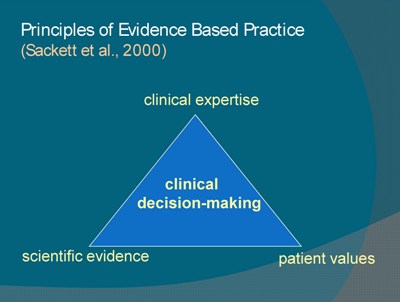
Principles of EBP

I'm going to talk about the scientific evidence today, and also apply what we learned from the scientific evidence and developing our own clinical expertise. The third piece, that I think plays a part even moreso in the swallowing realm but also does at times in the communication realm, is patient values.  We have to consider what the patient's desire is when looking at clinical interventions, and that influences decisions that we make with a patient.  But the challenge is to remain abreast of the scientific evidence. 

Several years ago Rob Mullen at ASHA had done a survey and had queried clinicians about what their  obstacles were to using evidence based practice. Definitely, getting to the evidence and having time to consume the evidence is a challenge.
This page is not available, because you are not logged in to your Professional or StudentUnion account.

The rest of this article is not available, because you are not logged in to your Professional or StudentUnion account.

Sign Up For Professional or StudentUnion to get the whole article and handouts.

This page is not available, because you are not logged in to your Professional or StudentUnion account.

This page is not available, because you are not logged in to your Professional or StudentUnion account.

This page is not available, because you are not logged in to your Professional or StudentUnion account.

This page is not available, because you are not logged in to your Professional or StudentUnion account.

This page is not available, because you are not logged in to your Professional or StudentUnion account.

This page is not available, because you are not logged in to your Professional or StudentUnion account.

This page is not available, because you are not logged in to your Professional or StudentUnion account.

This page is not available, because you are not logged in to your Professional or StudentUnion account.

This page is not available, because you are not logged in to your Professional or StudentUnion account.

This page is not available, because you are not logged in to your Professional or StudentUnion account.

This page is not available, because you are not logged in to your Professional or StudentUnion account.


Sign Up For Professional or StudentUnion   to get the whole article and handouts.
Anastasia Raymer, Ph.D
anastasia raymer

Dr. Anastasia Raymer is a Professor in the Department of Communication Disorders & Special Education at Old Dominion University, Norfolk, Virginia. She received her B.S.Ed. from the University of Wisconsin-Madison and her M.A. and Ph.D. in Speech Pathology from the University of Florida. For the past 25 years her research has examined the neural and cognitive mechanisms implicated in disorders of lexical and praxis processing, and means to promote optimal rehabilitation of these disorders in individuals with stroke-induced aphasia, dysgraphia, and limb apraxia. Her work is supported by the NIH (NIDCD) and the Dept of Defense. She has published more than 50 papers and chapters and has presented nationally and internationally. She is a Fellow of the American Speech-Language-Hearing Association and is former Coordinator of ASHA Special Interest Division 2.

Categories: ,

Related Classes

Presenter Course Action
Presenter: anastasia raymer
Anastasia Raymer
Constraint Induced Language Therapy for Aphasia
CEUs/Hours Offered: ASHA/0.1 Intermediate, Professional; CASLPA/1.0
Recorded Course: #4135 · Duration: 1 hour
In this course, we will review the principles of neuroplasticity that are the foundation for Constraint Induced Language Therapy (CILT) for aphasia. We will then examine evidence for the effects of CILT on measures of language functions and communication activity/participation. Neural correlates of CILT effects revealed in imaging studies will be summarized as well.
Presenter: barbara b shadden
Barbara B. Shadden
Working with Families of Older Language-impaired Adults
Wed, Jun 13, 2012 at 9:00 am PDT
CEUs/Hours Offered: ASHA/0.1 Introductory, Professional; CASLPA/1.0
Live Course: #5374 · Duration: 1 hour
When an aging adult experiences impairment of communication, family members face numerous challenges. This presentation focuses on working with families, particularly in the context of aphasia, with emphasis upon the role of families in rehabilitation and what SLPs can do to help families adjust and move forward with their own life stories.
Presenter: laura l murray
Laura L. Murray
Management of Executive Function Disorders in Adult Neurogenic Patient Populations
CEUs/Hours Offered: ASHA/0.2 Intermediate, Professional; CASLPA/2.0
Recorded Course: #3045 · Duration: 2 hours
This presentation provides an overview of executive functioning and how deficits within this cognitive domain manifest in adult clients with aphasia, cognitive-communicative disorders related to right hemisphere brain damage or traumatic brain injury, or dementia. Recently published procedures for assessing and treating executive dysfunction in adult clients with acquired neurogenic communication disorders are also discussed.
Presenter: laura l murray
Laura L. Murray
Rationale for and Review of Cognitive-Based Interventions for Aphasia
CEUs/Hours Offered: ASHA/0.2 Advanced, Professional; CASLPA/2.0
Recorded Course: #3299 · Duration: 2 hours
This presentation provides a rationale for adopting or incorporating cognitive-based treatment techniques into aphasia management programs. Recently published cognitive treatments utilized with aphasic patients as well as those that might be adapted for use with aphasia patients will be described and critically reviewed.
Presenter: audrey holland
Audrey Holland
Developing & Using Scripts in the Treatment of Aphasia, Apraxia of Speech, and TBI
CEUs/Hours Offered: ASHA/0.1 Intermediate, Professional; CASLPA/1.0
Recorded Course: #4982 · Duration: 1 hour
The rationale and potential uses of scripting techniques in the treatment of neurogenic disorders will be presented. Participants will learn how to develop personalized scripts, and how to use them in a variety of formats including simple paper and pencil, the use of apps and the use of virtual clinicians (VTs) for purposes of training and data collection.