This article is a written transcript of the course, “Effective Communication Strategies”, presented by Lisa Lucks Mendel, Ph.D. on June 7, 2011.
>> Amy Hansen: Welcome to this week's Virtual Conference on Topics in Supervision. We're very pleased to have Dr. Lisa Lucks Mendel joining us today for her Expert e-Seminar entitled, “Effective Communication Strategies.” At this time I am very pleased to introduce Lisa Lucks Mendel. Lisa holds a Bachelor's of Science and Master's of Education in Speech Pathology and Audiology from University of Georgia, and a Ph.D. in speech and hearing sciences from University of California Santa Barbara. She is currently an Associate Professor of Audiology at the University of Memphis in the School of Communication Sciences and Disorders. She is a licensed audiologist and hearing aid dispenser in the state of Tennessee. Dr. Lucks Mendel is an ASHA fellow and has published and presented several papers regarding speech perception assessment issues for individuals who have normal hearing and hearing impairments, and on counseling and supervision. So welcome, Lisa. Thank you so much for joining us today.
[Applause]
>> Dr. Mendel: Thank you, Amy. This is exciting. I feel a little bit like an imposter because I'm the only audiologist on the panel, but I'm really honored to speak with all of you. I want to thank Carol Dudding for including me on the panel as well and I understand her talk went very well yesterday. I hope to share some additional information with you in the next hour.
Before I do, I would like to get a sense of how many of you are brand new supervisors who have not done much supervising or within less than a year? Okay. Two of you. And how many of you are pretty experienced, say maybe one to five years worth of experience supervising? All right. So that is a good number of you as well. I see about 12 or so thumbs up. How many of you would consider yourselves old hats - you have been doing this 5 years and you know all the stuff I'm about to say? Okay, good. You old hats can correct me or add additional information. And I say that in a loving way of course.
But anyway, again, I'm glad to have you here and I hope to share some helpful information - some of which you may know, some of which you may not know, and some of which hopefully I can offer a different take on different aspects of things that you have been doing or would like to do in your role of clinical educators.
Overview
We're going to talk a little bit about your definition of supervision and look at how we move through the process of supervision. We'll actually look at Anderson's model of supervision (1988), which I think is a nice way to visualize the big picture in supervision. Then I'll look at some creative ways that our school has focused on enhancing communication, not only between clinical educators and students, but also among our faculty and others with whom we work. Then we'll get into some actual feedback strategies and how we can make them more effective and constructive, and lastly talk a bit about generational and cultural issues. Vicki McCready is going to be speaking much more about that tomorrow. But I'm going to highlight a couple of things she has published that are relevant to our topic today.
Supervisory Process
I view supervision as a process, and many others do, too. On this slide from Newman (below), you see his definition of the supervisory process.
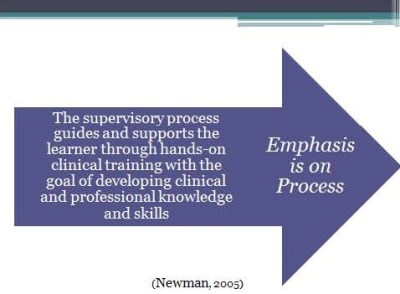
Supervision is not an entity in itself as much as it is really a level of interactive skill. So these skills that you currently have developed as clinical educators are tools that you use not only to help you in what you do, but also to help the students and clinician. As you know, most of us have been supervised by others, and then eventually we get asked to do the same. So how do we learn how to supervise? How we learn how to supervise often comes from those who taught us, and so it is helpful to have that connection between the two groups. It is also a process that is very dynamic and changes over time. We change as professionals and individuals, and certainly the students do as well. I will be repeating this concept of supervision being a process.