

Strength, Endurance and Exercise: Dining with Dysphagia

Presenter Course Action
Presenter: joanne robbins
JoAnne Robbins
Strength, Endurance and Exercise: Dining with Dysphagia
CEUs/Hours Offered: ASHA/0.1 Advanced, Professional; CASLPA/1.0
Text Course: #5176 · Duration: 1 hour
Underlying principles of oropharyngeal exercise for dysphagia rehabilitation are presented in the context of understanding swallowing neurophysiology and plasticity as the building blocks for dining; that is, eating a meal. Dining will be discussed as an endurance activity focusing on its relationship to strength and fatigue. Interventions to promote successful and safe dining including guidance on incorporating both compensatory and active rehabilitation techniques to create optimal, functional treatment plans throughout the continuum of dysphagia care will be presented.
Sign Up For Professional or StudentUnion   to get the whole article and handouts.
Sign Up For Professional or StudentUnion to get the whole article and handouts.
Print  

Communication access realtime translation (cart) is provided in order to facilitate communication accessibility and may not be totally verbatim. The consumer should check with the moderator for any clarifications of the material.

This text-based course is a written transcript of the event, “Strength, Endurance and Exercise: Dining with Dysphagia” presented by Dr. JoAnne Robbins, Ph.D., CCC-SLP on September 19, 2011.

>> Amy Hansen:  Good afternoon, everybody.  Welcome to this week's virtual conference on dysphasia management.  We're so pleased to have all of you joining us today and hopefully throughout the week to hear the latest in dysphagia management by an outstanding group of presenters.  Today's Expert e‑Seminar, “Strength, Endurance and Exercise: Dining with Dysphagia” is presented today by the highly accomplished Dr. JoAnne Robbins.  My name is Amy Hansen and I'll be your moderator for today's course.  I am very honored to introduce Dr. JoAnne Robbins to you this afternoon.  Dr. JoAnne Robbins is a tenured Professor in the Department of Medicine at the University of Wisconsin‑Madison where she holds affiliated professor appointments in radiology, nutritional sciences and bio‑medical engineering.  Dr. Robbins serves as Associate Director of Research for the Geriatric Research Education and Clinical Center at the Williams S. Middleton Memorial Veterans Hospital.  She has been caring for dysphagia patients in her clinical practice for more than 20 years.  Her research program has been funded by the National Institutes of Health and the Department of Veteran's Affairs for many years.  In addition to numerous peer‑reviewed publications, she also is co‑author of the Easy to Swallow, Easy to Chew cookbook published by John Wiley and Sons.  Dr. Robbins currently holds three US patents through the Wisconsin Alumni Research Foundation, and was President of the Dysphagia Research Society, and is honored as an ASHA fellow. We are very honored to have you with us this afternoon, Dr. Robbins.  Thank you so much for joining us.

[Applause]

>> JoAnne:  Thank you for having me, Amy, and thank you for the very nice introduction. 

I think we all agree that swallowing, or the endurance task of swallowing – eating – is a biopsychosocial activity that is a key element of Healthy Life.  Let’s define swallowing, to start out on the same foot, as moving material from the mouth through the esophagus into the stomach by a series of muscular actions, and then define dysphagia as a swallowing disorder characterized by difficulty moving the following materials into the stomach by a series of muscular actions.  We have food and liquid, but we don’t want to forget about secretions and medications, particularly those in healthcare settings.  Those of us working in medical settings want to be working with those providers, nurses, et cetera, to ensure that medications are swallowed in the patient’s best interest as well with some of the interventions in place that we'll talk about today.  Dysphagia is, I think we would all agree, an element of unhealthy life. 

Swallowing and swallowing disorders is a fairly new field or part of speech‑language pathology.  We're a young field studying swallowing.  It came into our scope paragraph in the late 1980s. Prior to that, this is a good image to remind us of the primary way patients with dysphagia were cared for:
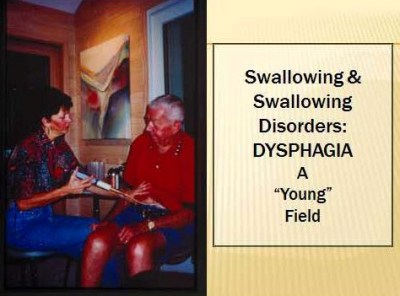
Figure 1

Gastrostomy tubes were put in the stomach and the oropharyngeal mechanism was bypassed essentially and patients were fed right into the lower part of the system.  This is actually somebody who became a patient here who had been told he would never eat by mouth.  He had a stroke, and he’d been around the circuit with speech pathologists.  This is his daughter here actually having a meal with him – he's doing all the consuming, of course, with her help.  We did, in fact, move this fellow from G‑tube feedings to full oral eating with some of the strategies that we will be talking about today. 
This page is not available, because you are not logged in to your Professional or StudentUnion account.

The rest of this article is not available, because you are not logged in to your Professional or StudentUnion account.

Sign Up For Professional or StudentUnion to get the whole article and handouts.

This page is not available, because you are not logged in to your Professional or StudentUnion account.

This page is not available, because you are not logged in to your Professional or StudentUnion account.

This page is not available, because you are not logged in to your Professional or StudentUnion account.

This page is not available, because you are not logged in to your Professional or StudentUnion account.

This page is not available, because you are not logged in to your Professional or StudentUnion account.

This page is not available, because you are not logged in to your Professional or StudentUnion account.

This page is not available, because you are not logged in to your Professional or StudentUnion account.

This page is not available, because you are not logged in to your Professional or StudentUnion account.


Sign Up For Professional or StudentUnion   to get the whole article and handouts.
JoAnne Robbins, Ph.D., CCC-SLP
joanne robbins

Dr. JoAnne Robbins is a tenured Professor in the Dept. of Medicine at the University of Wisconsin, Madison, where she also holds affiliate professor appointments in Radiology, Nutritional Sciences and Biomedical Engineering. Dr. Robbins serves as Associate Director of Research for the Geriatric Research, Education, and Clinical Center (GRECC) at the Wm. S. Middleton Memorial Veterans Hospital.  She has been caring for dysphagic patients in her clinical practice for more than 20 years. Her research program has been funded by the National Institutes of Health (NINDS, NIDCD) and the Department of Veterans Affairs for many years. In addition to numerous peer-reviewed publications, she also is co-author of the Easy to Swallow, Easy to Chew Cookbook published by John Wiley and Sons, New York.  Dr. Robbins currently holds three U.S. patents through the Wisconsin Alumni Research Foundation, was President of the Dysphagia Research Society and is honored as an ASHA Fellow. Affiliations include Swallow Solutions, LLC & Bracco Diagnostic Imaging

Categories: ,

Related Classes

Presenter Course Action
Presenter: joanne robbins
JoAnne Robbins
Strength, Endurance and Exercise: Dining with Dysphagia
CEUs/Hours Offered: ASHA/0.1 Advanced, Professional; CASLPA/1.0
Recorded Course: #5104 · Duration: 1 hour
Underlying principles of oropharyngeal exercise for dysphagia rehabilitation are presented in the context of understanding swallowing neurophysiology and plasticity as the building blocks for dining; that is, eating a meal. Dining will be discussed as an endurance activity focusing on its relationship to strength and fatigue. Interventions to promote successful and safe dining including guidance on incorporating both compensatory and active rehabilitation techniques to create optimal, functional treatment plans throughout the continuum of dysphagia care will be presented.
Presenter: gale estes waddell
Gale Estes-Waddell
Delightful Dysphagia Dining
CEUs/Hours Offered: ASHA/0.1 Intermediate, Professional; CASLPA/1.0
Recorded Course: #3815 · Duration: 1 hour
This presentation discusses modified dysphagia diets and the patients requiring a modified dysphagia diet. It explores how to ensure optimum safety, nutrition and "happiness" with a modified dysphagia diet.
Presenter: lori burkhead morgan
Lori Burkhead Morgan
The Dysphagia Workout: Applying exercise principles into treatment
CEUs/Hours Offered: ASHA/0.1 Intermediate, Professional; CASLPA/1.0
Recorded Course: #5107 · Duration: 1 hour
Clinicians frequently attempt to incorporate exercise into treatment sessions for dysphagia but have received little or no training on how to do so. This course will address what qualifies an activity as an exercise and how to turn therapy into a workout instead of a series of hit-or-miss activities.
Presenter: eric blicker
Eric Blicker
Dysphagia in the Trach and Vent Population
CEUs/Hours Offered: ASHA/0.1 Intermediate, Professional; CASLPA/1.0
Text Course: #4159 · Duration: 1 hour
The presentation is designed to guide the clinician through the process of assessment and treatment of patients with tracheostomy tubes and/or those patients who are ventilator dependent. The presentation will focus on tracheostomy tube sizing, speaking valve use, multidisciplinary team approach, trach cuff status, clinical assessment, and instrumental dysphagia assessment as components of patient care.
Presenter: michelle tristani
Michelle Tristani
Clinical Excellence in Dementia-Dysphagia Management
CEUs/Hours Offered: ASHA/0.1 Intermediate, Professional; CASLPA/1.0
Recorded Course: #3861 · Duration: 1 hour
The Speech Pathologist is often challenged clinically and professionally when the diagnoses of Dementia and Dysphagia is combined. Nutrition, hydration and quality of life are at stake. Assessment overview of Dementia and Dysphagia focuses on oral apraxia, oral acceptance, and oral preparatory skills. The SLP must uphold clinical recommendations based on bedside dysphagia and instrumental exams while simultaneously supporting the patient's right to refuse, preservation of dignity and quality of life. This seminar generates innovative diagnostic and treatment techniques, modifications and tools to effectively manage this powerful combination of disorders.