SpeechPathology.com Phone: 800-242-5183


Austill's Educational Therapy Services - Voice - November 2025

Textbook: Artificial Intelligence, Extended Reality, and Automation in Speech-Language Pathology: Integrating Technology Into Clinical Practice, First Edition

Textbook: Artificial Intelligence, Extended Reality, and Automation in Speech-Language Pathology: Integrating Technology Into Clinical Practice, First Edition
Michelle Boisvert, PhD, CCC-SLP, Nerissa Hall, PhD, CCC-SLP
December 31, 2025

To earn CEUs for this article, become a member.

unlimited ceu access $129/year

Join Now

Please note that to complete this course, you will need to read the textbook Artificial Intelligence, Extended Reality, and Automation in Speech-Language Pathology: Integrating Technology Into Clinical Practice, First Edition. If you do not already have a copy of the textbook, you can purchase it at Plural Publishing.
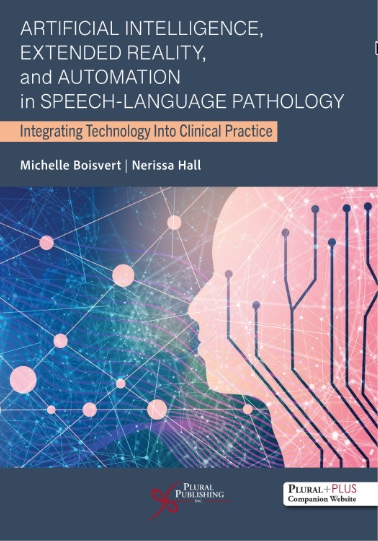
Image of book

FAQ: SpeechPathology.com Textbook Continuing Education (CE) Courses 

What is a textbook CE course? 

Our textbook CE courses constitute the CE activity for their respective textbooks. Essentially, these courses provide a way to earn CEUs for the time and effort our members invest in reading these valuable texts. 

Do I need materials for these courses?

Yes! You will need the relevant textbook for any textbook-based courses you wish to take. 

Does SpeechPathology.com charge extra fees for textbook-based courses? 

No. You are responsible for purchasing your textbook, and (as with our other courses) you will need a current SpeechPathology.com membership. SpeechPathology.com does not collect any additional fees for these courses. 

Where is the course content? How do I take this course?

First, register for the course to confirm current availability. Once registered, the course stays in your 'Pending Courses' for 30 days, during which time you must purchase and read the textbook. To receive credit, you must complete the exam before your 30-day registration period ends. Availability is not guaranteed once your 30-day registration expires.

The exam itself is the CE activity you need to complete to earn CEUs for this textbook. 

Questions?
Reach out to  if you have questions or need assistance.
 

To earn CEUs for this article, become a member.

unlimited ceu access $129/year

Join Now

michelle boisvert

Michelle Boisvert, PhD, CCC-SLP

Michelle Boisvert, PhD, CCC-SLP is a doctoral-level clinician providing and supervising high-quality speech and language services on-site and remotely in a public school and private practice setting. Dr. Boisvert received her PhD in Communication Disorders from the University of Massachusetts Amherst in 2012, where she investigated the viability, use, and effectiveness of telepractice for the online delivery of speech and language services, specifically for individuals with autism spectrum disorders. Her research helped validate this method of service delivery and has informed her clinical and entrepreneurial work post graduation. Driven by a passion for leveraging technology to ensure access to high-caliber services and to enhance workload efficiency, Dr. Boisvert subsequently cofounded and developed the software easyReportPRO.com, a division of WorldTide, Inc. The customizable easyReportPRO is an innovative online platform designed to streamline report writing for speech-language pathologists (SLPs) using customizable, automated templates. With a focus on continuous improvement and a drive to advance tech-based resources for SLPs and related fields, Dr. Boisvert has always been committed to bridging the gap between clinical work and technology, offering SLPs tangible and practical solutions to reduce manual tasks and improve professional outcomes. Dr. Boisvert has published several articles in peer-reviewed journals on the topic of telepractice and is the former editor for the Perspectives on Telepractice (a journal published by Perspectives of the American Speech-Language-Hearing Association’s Special Interest Groups [ASHA’s SIG 18]). Dr. Boisvert provides training on the use of telepractice and has spoken at national and international conferences on this topic. She also offers professional training on entrance and exit criteria for speech and language services for students in U.S. public schools, specialist and teacher collaboration methods, as well as caseload management strategies that incorporate the use of artificial intelligence, extended reality, and automation.


nerissa hall

Nerissa Hall, PhD, CCC-SLP

Nerissa Hall, PhD, CCC-SLP is cofounder of Commūnicāre, LLC, and the Speech Language and Literacy Center at Tate Behavioral, Inc. Dr. Hall’s love for applied technology started as an undergraduate studying psychology at the University of Massachusetts Amherst where she was encouraged to apply for an internship with the speech-language pathologists working for the Department of Developmental Services (DDS). Her volunteer experience turned into a dual major (psychology and communication disorders) and a speech-language pathology assistant position with DDS, where she assumed responsibility for designing and developing lite-tech augmentative and alternative communication (AAC) systems, as well as programming and implementing high-tech speech-generating devices for adults with complex communication needs. Dr. Hall went on to get her master’s and PhD degrees from the University of Massachusetts Amherst. Her clinical work and experiences, upbringing in Cape Town, South Africa, plus her desire to ensure access to high-quality AAC services irrespective of geographical locale, evolved into her clinical work and research interests focusing on AAC, tele-AAC (AAC service delivery online), and the innovative use and application of current and available technology to support access and enhancement of AAC for people with complex communication needs. During her doctoral program, Dr. Hall cofounded Commūnicāre, LLC (a private practice focusing on AAC), with her mentor and colleague, Hillary Jellison. Together they developed a specialty practice, pioneering innovative AAC assessment, intervention, and consultation work. They extended their reach by incorporating synchronous (real-time) and asynchronous (overtime) telepractice to diversify their methodology and application of clinical services through collaborative research and service delivery. Since graduating, Dr. Hall has continued to grow her practice, merging with behavioral health leaders at Tate Behavioral, where clinical practice is merged with rigorous data collection to systematically explore innovative technologies and refine service delivery outcomes for neurodivergent individuals with complex communication needs, benefiting from AAC. Dr. Hall has presented nationally regarding AAC, tele-AAC, and artificial intelligence (AI). She has served as a LEND Fellow, adjunct faculty at Elms, Cambridge College, and UMass-Amherst. Dr. Hall coedited Tele-AAC: Augmentative and Alternative Communication Through Telepractice and Fundamentals of AAC: A Case-Based Approach to Enhancing Communication, and is passionate about advancing the field to ensure meaningful outcomes for individuals with complex communication needs, those using AAC, and the teams and communities that support them.


Related Courses

Textbook: Achieving Communication Competence
Presented by Yvonne Gillette, PhD, ASHA Fellow
Text
Course: #10517Level: Advanced15 Hours
Based on the textbook, Achieving Communication Competence, this course describes a three-step process to create an effective intervention plan for people with severe communication disabilities. Assessment of environmental factors and communication skills, implementation and modification of intervention plans, and progress reporting are discussed.

Textbook: Writing Measurable IEP Goals and Objectives
Presented by Cynthia Herr, PhD, Barbara Bateman, PhD
Text
Course: #10533Level: Intermediate7.5 Hours
Based on the textbook Writing Measurable IEP Goals and Objectives, this course discusses the concept of measurability and how to incorporate a child’s unique needs into legally correct and clear IEP goals and measurable objectives. Case studies provide best-practice examples of goals/objectives for a variety of scenarios.

Textbook: Aligning IEPs to State Standards
Presented by Ginevra Courtade, PhD, Diane Browder, PhD
Text
Course: #10534Level: Intermediate8.5 Hours
Based on the textbook Aligning IEPs to State Standards, this course describes the link between state/federal requirements, state standards, and general education curricula, and how to align IEP goals/objectives with these standards. Case examples are discussed that incorporate multiple academic content areas, as well as assistive technology and self-determination, into IEPs for students with moderate to severe disabilities.

Textbook: Evaluating and Enhancing Children's Phonological Systems - Research and Theory to Practice, Third Edition
Presented by Barbara W. Hodson, PhD
Text
Course: #11104Level: Advanced16.5 Hours
This course is based on the third edition of the textbook Evaluating & Enhancing Children's Phonological Systems: Research & Theory to Practice by Barbara W. Hodson. It presents the knowledge and skills needed to plan evaluations and implement optimal treatment for individuals with highly unintelligible speech. Topics also include phonetics, phonological development/speech sound acquisition, an overview of the diagnostic process, and various intervention approaches, including the Cycles Approach and its application to bilingual/multilingual individuals and special populations.

Textbook: Guide to Clinical Supervision
Presented by Angela Sterling-Orth, MS, CCC-SLP, Patricia Schraeder, MS, CCC-SLP, Ginevra Courtade, PhD
Text
Course: #10099Level: Advanced4.5 Hours
This course, which is based on the textbook Guide to Clinical Supervision, provides tools, tips, and strategies needed to navigate the complex nature of the supervisory process. Evidence-based supervisory models are discussed, along with methods for building relationships, providing feedback and resolving conflict. Easy-to-use resources are also provided.