

SpeechPathology.com Phone: 800-242-5183


Therapy Source Career Center - June 2019

Common Types of Tympanograms

Jen Duffey ., M.S.,CCC

May 14, 2007

Share:

Question

As a speech pathologist, I routinely come across reports documenting tympanogram results. Can you run down the list of common tympanogram types?

Answer

To understand the types of tympanograms, you should first understand the meaning behind the parts of the graph itself. A tympanogram provides information regarding the compliance of the middle ear system (how well sound passes through the eardrum to the middle ear system), ear canal volume, and middle ear pressure. Compliance is plotted vertically on the tympanogram, and is measured in ml or mmho. Maximum compliance of the middle ear system occurs when the pressure in the middle ear cavity is equal to the pressure in the external auditory canal. This compliance (static acoustic admittance) is represented by the highest peak of the curve on the graph (Figure 1). Pressure is indicated on the horizontal axis of the graph, and is measured in decaPascals.
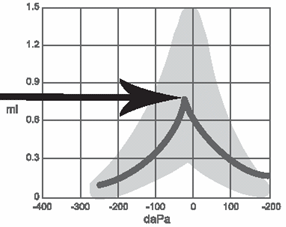
Tympanogram showing maximum peak compliance within the normal range

Figure 1. Tympanogram showing maximum peak compliance.

The classification system for tympanograms commonly used today was developed by Liden (1969) and Jerger (1970). There are three main types of tympanograms: A, B, and C. Type A tympanograms look like a teepee, and indicate a normal middle ear system, free of fluid or physiological anomalies which would prevent the admittance of sound from the middle ear into the cochlea. Figure 1 shows an example of a Type A tympanogram.

Type B tympanograms are a flat line (Figure 2), which is consistent with middle ear pathology, such as fluid or infection behind the ear drum. In some cases, these tympanograms are seen when there is a hole in the ear drum; the difference lies in the ear canal volume: a larger ear canal volume indicates a perforation in the ear drum.
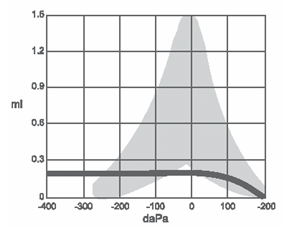
Flat Type B abnormal tympanogram

Figure 2. Type B tympanogram

Type C tympanograms (Figure 3) are still shaped like a teepee, but are shifted negatively on the graph. This indicates negative pressure in the middle ear space, often consistent with sinus or allergy congestion, or the end-stages of a cold or ear infection.
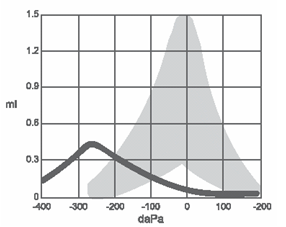
Type C tympanogram showing negative peak pressure

Figure 3. Type C tympanogram

References

Jerger, J.F. (1970). Clinical experience with impedence audiometry. Archives of Otolaryngology, 92, 311-324.

Liden, G. (1969). The scope and application of current audiometric tests. Journal of Laryngology and Otology, 83, 507-520.

Jen Duffey, M.S., CCC-A has been an audiologist for Maico-Diagnostics (www.maico-diagnostics.com) for three years. She provides audiological support and education, input for new product design and function, and technical assistance. Previously, she worked for three years as an educational audiologist providing clinical services to students, ages 2 to 21 years old.


Jen Duffey ., M.S.,CCC


Related Courses

The Ripple Effect of Stuttering: A Community-Based Approach
Presented by Craig Coleman, MA, CCC-SLP, BCS-F, ASHA Fellow, Mary Weidner, PhD, CCC-SLP
Video

Presenters

Craig Coleman, MA, CCC-SLP, BCS-F, ASHA FellowMary Weidner, PhD, CCC-SLP
Course: #9217Level: Intermediate2 Hours
  'Very helpful to know about parent beliefs and the importance of including them in the therapy process'   Read Reviews
This is Part 2 of a four-part series. The stuttering experience has a ripple effect that extends far beyond the child who stutters. Parents, teachers, peers, and others must possess both knowledge and skills to best support children who stutter. This course will highlight new clinical tools and resources to provide a community-based treatment approach for stuttering. (Part 1 - Course 9278, Part 3 - Course 9301, Part 4 - Course 9304)

20Q: Infection Control Strategies for SLPs
Presented by A.U. Bankaitis Smith, PhD
Text

Presenter

A.U. Bankaitis Smith, PhD
Course: #9729Level: Intermediate1 Hour
  'Easy to read and answered all topics covered'   Read Reviews
Speech-language pathologists are expected by policy authorities to apply appropriate measures to protect patients, co-workers and themselves in clinical situations that may expose individuals to infectious microbes. This article provides practical guidelines for implementing infection control principles within the context of the COVID-19 pandemic, including discussion of personal protective equipment (PPE) and disinfecting and cleaning products.

Thickened Liquids in Clinical Practice: The Plot “Thickens”
Presented by Angela Mansolillo, MA, CCC-SLP, BCS-S
Video

Presenter

Angela Mansolillo, MA, CCC-SLP, BCS-S
Course: #10497Level: Intermediate1 Hour
  'Great information'   Read Reviews
Clinicians who utilize thickened liquids in their clinical practice are aware of their benefits, but what about the risks and contraindications? Advantages and disadvantages of thickened liquids are reviewed in this course with a focus on clinical outcomes, including impacts on medication administration, lung health, and hydration. Product types are evaluated to facilitate appropriate choices for individual clients.

SLP in the NICU: An Overview
Presented by Anna Manilla, MS, CCC-SLP, CLC
Video

Presenter

Anna Manilla, MS, CCC-SLP, CLC
Course: #11267Level: Introductory1 Hour
  'I highly recommend this course! Teacher taught in a way that was engaging and easy to understand, kept me engaged'   Read Reviews
This course provides an introductory overview of Speech-Language Pathology services in the Neonatal Intensive Care Unit (NICU), including the unique environment, the SLP’s role, and key components of neonatal care. Topics include cue-based and supportive feeding strategies, instrumental assessments, and approaches for empowering and supporting parents and caregivers.

Dysphagia in Neurodegenerative Disease
Presented by Debra M. Suiter, PhD, CCC-SLP, BCS-S
Video

Presenter

Debra M. Suiter, PhD, CCC-SLP, BCS-S
Course: #9732Level: Intermediate1 Hour
  'Good comparisons between ALS/ PD with appropriate types of interventions'   Read Reviews
Dysphagia is common in individuals with amyotrophic lateral sclerosis (ALS) and Parkinson’s disease. This course discusses the underlying pathophysiology and appropriate treatment programs for each disease, as well as use of alternate methods of nutrition/hydration.

Our site uses cookies to improve your experience. By using our site, you agree to our Privacy Policy.