

This text-based course is a written transcript of recorded course, "Auditory Verbal Therapy for the New Generation of Children with Hearing Impairments", presented by Denise Wray on April 18, 2011.
This text is being provided in a rough draft format. Communication access realtime translation (cart) is provided in order to facilitate communication accessibility and may not be totally verbatim. The consumer should check with the moderator for any clarifications of the material.
Click Here to View Supplemental Handouts
Click Here to View Resource List
>> Amy Hansen: Good afternoon, everyone, welcome to today's Expert e Seminar, "Auditory Verbal Therapy for the New Generation of Children with Hearing Impairments" presented today by Dr. Denise Wray. Denise Wray is a Professor in the School of Speech-Language Pathology and Audiology at the University of Akron. She has co-directed the Auditory Verbal Clinic in the University's Audiology and Speech Center for more than two decades. Her research interest areas involve literacy development in children with hearing loss who are learning to listen and speak using their technology. She has authored or co-authored over 25 articles. She has co-directed two grants including the Auditory Options Project working with the Ohio Department of Health for the birth to three years old who have hearing loss and a U.S. Department of Education grant developing a specialty area for SLPs working with children with hearing loss. So welcome, Denise, and thank you so much for sharing your expertise with us today.
[Applause]
>> Dr. Denise Wray: Thank you, Amy. First of all I want to thank all of you for joining us this afternoon on this wonderful topic, a topic that has comprised most of my professional career. I began in this field because we have hearing loss in our family. I always thought there could have been academically and emotionally a better opportunity for this relative. I also had the good fortune - you've heard the expression location, location, location - I, fortunately, was able to have my office next to Dr. Carol Flexer who is a retired distinguished Professor in audiology from the University of Akron. Our rooms were next to each other and I was able to overhear her conversations as she trained students to work with children with hearing loss in the early 80s and I became fascinated - fascinated with the technologies that she brought to our clinic and what the outcomes were that she was achieving even back in the 80s with linear hearing aids prior to cochlear implants. But I'm so fortunately that you are here today because I'm assuming that you want to be a leader in aural rehab for this new generation of children with hearing loss. As we will discover today, the evidence-based research continues to mount and reveals very promising outcomes for children with hearing loss.
If you need to reach me after this lecture at any time you can see my e-mail is listed so feel free to contact me. As Amy mentioned I've been co-director, now sole Director, of the early intervention clinic at the University of Akron. I do see children, even young adults, who are early cochlear implant recipients or early digital hearing aid recipients but I also see those children who are late recipients as well. So there is some bridging that has to go on. It is more post cochlear implant therapy because the families desire that the children become better listeners and spoken language users.
I also want to direct you to something not on the slide; a website you might find very helpful. Amy mentioned that I have a U.S. Department of Ed. grant that is a collaborative with Kent State University and we have created a website and that is www.auditoryoptions.org. On auditoryoptions.org you can find sample auditory lesson plans, you can find a link to research, you can find what an auditory lesson plan looks like; and, also, an explanation of our training program. So you might find that to be very helpful. There is also a link to recommended resources for those that are attempting to use auditory-based philosophy. I thought I would mention that.
I also would like to begin with this beautiful baby which used to appear in the back of the Volta Review. Some of you may recall this adorable face.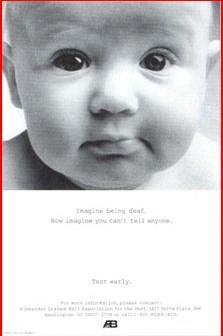
Auditory-Verbal Therapy for the New Generation of Children with Hearing Impairments
May 4, 2011

Related Courses
1
https://www.speechpathology.com/slp-ceus/course/supporting-deaf-hard-hearing-child-1033848
Supporting the Deaf & Hard of Hearing Child: The Professional’s Role in a Family’s Journey
Imperative education and resources to be provided by professionals to parents during the delicate time of identification of hearing loss is discussed in this course. Stages of grief, facilitating shared decision-making for communication as a family, and significant roles to know and consider are covered.
auditory, textual, visual
129
USD
Subscription
Unlimited COURSE Access for $129/year
OnlineOnly
SpeechPathology.com
www.speechpathology.com
Supporting the Deaf & Hard of Hearing Child: The Professional’s Role in a Family’s Journey
Imperative education and resources to be provided by professionals to parents during the delicate time of identification of hearing loss is discussed in this course. Stages of grief, facilitating shared decision-making for communication as a family, and significant roles to know and consider are covered.
1033848
Online
PT60M
Supporting the Deaf & Hard of Hearing Child: The Professional’s Role in a Family’s Journey
Presented by Michelle Hu, AuD
Course: #1033848Level: Introductory1 Hour
AG Bell - LSLS/1.0 Domain 2, Domain 5; ASHA/0.1 Introductory, Professional; Calif SLPAB/1.0; IACET/0.1; IL EITP/1.0; Kansas LTS-S1370/1.0; SAC/1.0
Imperative education and resources to be provided by professionals to parents during the delicate time of identification of hearing loss is discussed in this course. Stages of grief, facilitating shared decision-making for communication as a family, and significant roles to know and consider are covered.
2
https://www.speechpathology.com/slp-ceus/course/evaluation-children-with-hearing-loss-8876
Evaluation of Children with Hearing Loss and Suspected Autism Spectrum Disorder: An Early Intervention Perspective
This course will examine the similarities and differences between hearing loss (HL) and autism spectrum disorder (ASD) so that SLPs can assist in differential diagnosis for children 0-3 years old. Evaluation tools, speech/language characteristics of the degrees of hearing loss, listening skill progression, and typical pragmatic skill development of children with hearing loss will also be discussed.
auditory, textual, visual
129
USD
Subscription
Unlimited COURSE Access for $129/year
OnlineOnly
SpeechPathology.com
www.speechpathology.com
Evaluation of Children with Hearing Loss and Suspected Autism Spectrum Disorder: An Early Intervention Perspective
This course will examine the similarities and differences between hearing loss (HL) and autism spectrum disorder (ASD) so that SLPs can assist in differential diagnosis for children 0-3 years old. Evaluation tools, speech/language characteristics of the degrees of hearing loss, listening skill progression, and typical pragmatic skill development of children with hearing loss will also be discussed.
8876
Online
PT90M
Evaluation of Children with Hearing Loss and Suspected Autism Spectrum Disorder: An Early Intervention Perspective
Presented by Wendy Deters, MS, CCC-SLP, LSL Cert AVEd
Course: #8876Level: Intermediate1.5 Hours
AG Bell - LSLS/1.5 Domain 1, Domain 2, Domain 3, Domain 4, Domain 6; ASHA/0.15 Intermediate, Professional; Calif SLPAB/1.5; IACET/0.2; IBCCES/1.5; IL EITP/1.5; Kansas LTS-S1370/1.5; SAC/1.5
This course will examine the similarities and differences between hearing loss (HL) and autism spectrum disorder (ASD) so that SLPs can assist in differential diagnosis for children 0-3 years old. Evaluation tools, speech/language characteristics of the degrees of hearing loss, listening skill progression, and typical pragmatic skill development of children with hearing loss will also be discussed.
3
https://www.speechpathology.com/slp-ceus/course/navigating-early-hearing-detection-and-1033912
Navigating the Early Hearing Detection and Intervention (EHDI) System, in partnership with American Cochlear Implant Alliance
This two-part series will provide important background and guidance for Speech Language Pathologists, Audiologists, Educators and others who serve children whose hearing loss was early identified to help professionals support families to access the services and support that they need for their child. The program will be of interest to both those with little knowledge of the EHDI system and those with more extensive background as we address both programmatic elements and the barriers that may prevent a child from receiving services in a timely manner.
auditory, textual, visual
129
USD
Subscription
Unlimited COURSE Access for $129/year
OnlineOnly
SpeechPathology.com
www.speechpathology.com
Navigating the Early Hearing Detection and Intervention (EHDI) System, in partnership with American Cochlear Implant Alliance
This two-part series will provide important background and guidance for Speech Language Pathologists, Audiologists, Educators and others who serve children whose hearing loss was early identified to help professionals support families to access the services and support that they need for their child. The program will be of interest to both those with little knowledge of the EHDI system and those with more extensive background as we address both programmatic elements and the barriers that may prevent a child from receiving services in a timely manner.
1033912
Online
PT120M
Navigating the Early Hearing Detection and Intervention (EHDI) System, in partnership with American Cochlear Implant Alliance
Presented by Linda Hazard, EdD, MS, Donna L. Sorkin, MA
Course: #1033912Level: Intermediate2 Hours
AG Bell - LSLS/2.0 Domain 1, Domain 2; ASHA/0.2 Intermediate, Related; Calif SLPAB/2.0; IACET/0.2; IL EITP/2.0; Kansas LTS-S1370/2.0; SAC/2.0
This two-part series will provide important background and guidance for Speech Language Pathologists, Audiologists, Educators and others who serve children whose hearing loss was early identified to help professionals support families to access the services and support that they need for their child. The program will be of interest to both those with little knowledge of the EHDI system and those with more extensive background as we address both programmatic elements and the barriers that may prevent a child from receiving services in a timely manner.
4
https://www.speechpathology.com/slp-ceus/course/acia-ehdi-101-1033913
Early Hearing Detection and Intervention 101, in partnership with American Cochlear Implant Alliance
This is part 1 of a 2-part course. Early Hearing Detection and Intervention (EHDI) 101 will describe the complex system of care that has evolved over the last 22-plus years. This presentation will include an overview as well as new, emerging initiatives and how you can collaborate with your state of territory program.
auditory, textual, visual
129
USD
Subscription
Unlimited COURSE Access for $129/year
OnlineOnly
SpeechPathology.com
www.speechpathology.com
Early Hearing Detection and Intervention 101, in partnership with American Cochlear Implant Alliance
This is part 1 of a 2-part course. Early Hearing Detection and Intervention (EHDI) 101 will describe the complex system of care that has evolved over the last 22-plus years. This presentation will include an overview as well as new, emerging initiatives and how you can collaborate with your state of territory program.
1033913
Online
PT60M
Early Hearing Detection and Intervention 101, in partnership with American Cochlear Implant Alliance
Presented by Linda Hazard, EdD, MS, Donna L. Sorkin, MA
Course: #1033913Level: Intermediate1 Hour
AG Bell - LSLS/1.0 Domain 1, Domain 2; ASHA/0.1 Intermediate, Related; Calif SLPAB/1.0; IACET/0.1; IL EITP/1.0; Kansas LTS-S1370/1.0; SAC/1.0
This is part 1 of a 2-part course. Early Hearing Detection and Intervention (EHDI) 101 will describe the complex system of care that has evolved over the last 22-plus years. This presentation will include an overview as well as new, emerging initiatives and how you can collaborate with your state of territory program.
5
https://www.speechpathology.com/slp-ceus/course/barriers-children-ehdi-acia-1033914
Barriers to Enrolling Children with Hearing Loss in Early Intervention, in partnership with American Cochlear Implant Alliance
This is part 2 of a 2-part course. Passage of Early Hearing Detection and Intervention (EHDI) has led to dramatic increases in newborn hearing screening, but early intervention of identified children still falls short, with up to 30% of identified children not receiving definitive hearing testing or intervention after initial screening—a phenomenon known as “lost to follow-up.” This presentation reviews the specific barriers associated with the failure of children to receive timely services, including inequities posed by Medicaid, complex enrollment processes, and lack of understanding by many parents and PCPs of the importance of timely follow-up.
auditory, textual, visual
129
USD
Subscription
Unlimited COURSE Access for $129/year
OnlineOnly
SpeechPathology.com
www.speechpathology.com
Barriers to Enrolling Children with Hearing Loss in Early Intervention, in partnership with American Cochlear Implant Alliance
This is part 2 of a 2-part course. Passage of Early Hearing Detection and Intervention (EHDI) has led to dramatic increases in newborn hearing screening, but early intervention of identified children still falls short, with up to 30% of identified children not receiving definitive hearing testing or intervention after initial screening—a phenomenon known as “lost to follow-up.” This presentation reviews the specific barriers associated with the failure of children to receive timely services, including inequities posed by Medicaid, complex enrollment processes, and lack of understanding by many parents and PCPs of the importance of timely follow-up.
1033914
Online
PT60M
Barriers to Enrolling Children with Hearing Loss in Early Intervention, in partnership with American Cochlear Implant Alliance
Presented by Donna L. Sorkin, MA
Course: #1033914Level: Intermediate1 Hour
AG Bell - LSLS/1.0 Domain 1, Domain 2; ASHA/0.1 Intermediate, Related; Calif SLPAB/1.0; IACET/0.1; IL EITP/1.0; Kansas LTS-S1370/1.0; SAC/1.0
This is part 2 of a 2-part course. Passage of Early Hearing Detection and Intervention (EHDI) has led to dramatic increases in newborn hearing screening, but early intervention of identified children still falls short, with up to 30% of identified children not receiving definitive hearing testing or intervention after initial screening—a phenomenon known as “lost to follow-up.” This presentation reviews the specific barriers associated with the failure of children to receive timely services, including inequities posed by Medicaid, complex enrollment processes, and lack of understanding by many parents and PCPs of the importance of timely follow-up.