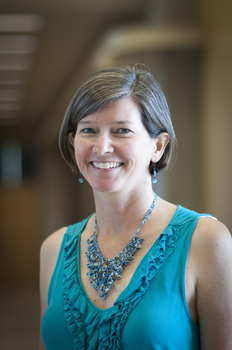
Dyslexia can certainly co-occur with apraxia of speech. When we think of childhood apraxia of speech, we are thinking of that as the motor sequencing, the ability to plan the motor sequence for articulation. Children who have dislexia, which is actually a pretty heterogeneous group, are really struggling with decoding sounds and putting them together to form words.
Dr. Amy Skinder Meredith is an experienced clinician who has worked in the public schools, hospitals, and private practice settings for 20 years. Her primary clinical and research interest is in children with motor speech disorders, and she has published and presented her research on childhood apraxia of speech (CAS) at national conferences.
Amy Skinder-Meredith, PhD, CCC-SLP
Dr. Skinder-Meredith received her doctorate from the University of Washington in 2000. She is currently an Associate Clinical Professor at Washington State University in Spokane, WA. She is an experienced clinician who has worked in the public schools, hospitals, and private practice settings for 20 years. Her primary clinical and research interest is in children with motor speech disorders, and she has published and presented her research on childhood apraxia of speech (CAS) at national conferences. She has also been active in international outreach in China and Guatemala, working with children with motor speech disorders, cleft lip and palate, and intellectual disabilities. Dr. Skinder-Meredith has given numerous workshops for practicing speech-language pathologists across the country on assessment and treatment of CAS. She also has great interest in craniofacial anomalies and counseling skills in the field of communication disorders. She has two adopted children with cleft lip and palate, which has allowed her to experience the roles of parent and professional in regards to children with communication impairments.
Related Courses
1https://www.speechpathology.com/slp-ceus/course/textbook-here-s-to-treat-10674Textbook: Here’s How to Treat Childhood Apraxia of Speech: 3rd EditionBased on the textbook Here’s How to Treat Childhood Apraxia of Speech (CAS): Third Edition, this course discusses the most current research regarding the nature of CAS, best practices in evaluation, and effective treatment approaches, along with considerations related to motor learning and co-occurring challenges. It provides a holistic overview of the complex needs of children with CAS at various stages of development.textual, visual129USDSubscriptionUnlimited COURSE Access for $129/yearOnlineOnlySpeechPathology.comwww.speechpathology.comTextbook: Here’s How to Treat Childhood Apraxia of Speech: 3rd EditionBased on the textbook Here’s How to Treat Childhood Apraxia of Speech (CAS): Third Edition, this course discusses the most current research regarding the nature of CAS, best practices in evaluation, and effective treatment approaches, along with considerations related to motor learning and co-occurring challenges. It provides a holistic overview of the complex needs of children with CAS at various stages of development.10674OnlinePT1470M
Based on the textbook Here’s How to Treat Childhood Apraxia of Speech (CAS): Third Edition, this course discusses the most current research regarding the nature of CAS, best practices in evaluation, and effective treatment approaches, along with considerations related to motor learning and co-occurring challenges. It provides a holistic overview of the complex needs of children with CAS at various stages of development.
2https://www.speechpathology.com/slp-ceus/course/20q-continuum-approach-for-sorting-1000820Q: A Continuum Approach for Sorting Out Processing DisordersThere is a good deal of confusion among audiologists and speech-language pathologists when a diagnosis of “processing disorder” is introduced. This course presents a continuum model to differentiate processing disorders into acoustic, phonemic, or linguistic aspects so that assessment and treatment can become more focused and effective. The roles of audiologists and SLPs in relation to processing disorders are described, and compensatory strategies for differing aspects of processing are presented.textual, visual129USDSubscriptionUnlimited COURSE Access for $129/yearOnlineOnlySpeechPathology.comwww.speechpathology.com20Q: A Continuum Approach for Sorting Out Processing DisordersThere is a good deal of confusion among audiologists and speech-language pathologists when a diagnosis of “processing disorder” is introduced. This course presents a continuum model to differentiate processing disorders into acoustic, phonemic, or linguistic aspects so that assessment and treatment can become more focused and effective. The roles of audiologists and SLPs in relation to processing disorders are described, and compensatory strategies for differing aspects of processing are presented.10008OnlinePT60M
There is a good deal of confusion among audiologists and speech-language pathologists when a diagnosis of “processing disorder” is introduced. This course presents a continuum model to differentiate processing disorders into acoustic, phonemic, or linguistic aspects so that assessment and treatment can become more focused and effective. The roles of audiologists and SLPs in relation to processing disorders are described, and compensatory strategies for differing aspects of processing are presented.
3https://www.speechpathology.com/slp-ceus/course/20q-using-speech-science-in-1032620Q: Using Speech Science in Clinical PracticeMany speech-language pathology clinicians find speech science daunting and not applicable to their clinical practice. This course discusses why and how speech science is useful in understanding speech disorders and differences. Examples are provided of how to assess and treat speech disorders using speech science-based principles and techniques such as the source-filter theory and acoustic, physiologic and biofeedback measures.textual, visual129USDSubscriptionUnlimited COURSE Access for $129/yearOnlineOnlySpeechPathology.comwww.speechpathology.com20Q: Using Speech Science in Clinical PracticeMany speech-language pathology clinicians find speech science daunting and not applicable to their clinical practice. This course discusses why and how speech science is useful in understanding speech disorders and differences. Examples are provided of how to assess and treat speech disorders using speech science-based principles and techniques such as the source-filter theory and acoustic, physiologic and biofeedback measures.10326OnlinePT60M
'This course verifies that speech science is a valuable and effective area of learning for both students and clinicians of Speech Pathology'Read Reviews
Many speech-language pathology clinicians find speech science daunting and not applicable to their clinical practice. This course discusses why and how speech science is useful in understanding speech disorders and differences. Examples are provided of how to assess and treat speech disorders using speech science-based principles and techniques such as the source-filter theory and acoustic, physiologic and biofeedback measures.
4https://www.speechpathology.com/slp-ceus/course/bringing-literacy-to-life-in-11111Bringing Literacy to Life in Speech Therapy, Part 1This is Part 1 of a two-part series. This course describes the benefits of integrating literacy into speech-language therapy and discusses using a multimodal, multisensory approach to optimize engagement and gains across developmental domains.auditory, textual, visual129USDSubscriptionUnlimited COURSE Access for $129/yearOnlineOnlySpeechPathology.comwww.speechpathology.comBringing Literacy to Life in Speech Therapy, Part 1This is Part 1 of a two-part series. This course describes the benefits of integrating literacy into speech-language therapy and discusses using a multimodal, multisensory approach to optimize engagement and gains across developmental domains.11111OnlinePT60M
This is Part 1 of a two-part series. This course describes the benefits of integrating literacy into speech-language therapy and discusses using a multimodal, multisensory approach to optimize engagement and gains across developmental domains.
5https://www.speechpathology.com/slp-ceus/course/bringing-literacy-to-life-in-11112Bringing Literacy to Life in Speech Therapy, Part 2This is Part 2 of a two-part series. Evidence-based strategies to meaningfully incorporate literacy in speech therapy sessions are described in this course. Bringing literacy to life through multi-modal and multi-sensory experiences is also discussed.auditory, textual, visual129USDSubscriptionUnlimited COURSE Access for $129/yearOnlineOnlySpeechPathology.comwww.speechpathology.comBringing Literacy to Life in Speech Therapy, Part 2This is Part 2 of a two-part series. Evidence-based strategies to meaningfully incorporate literacy in speech therapy sessions are described in this course. Bringing literacy to life through multi-modal and multi-sensory experiences is also discussed.11112OnlinePT60M
This is Part 2 of a two-part series. Evidence-based strategies to meaningfully incorporate literacy in speech therapy sessions are described in this course. Bringing literacy to life through multi-modal and multi-sensory experiences is also discussed.