
Introduction
Although eyes occupy a prominent position in the human face, the information they can provide about presence of communication disorders often goes unnoticed during an oral-facial examination. Many speech-language pathologists (SLPs) associate eye examination with vision testing, and rightly believe that vision assessment does not fall within the responsibilities of a speech-language pathologist. Visual acuity, however, is only one aspect of eye examination. Eye orientation, color, and appearance can provide useful diagnostic information as to presence and type of communication disorders, particularly those disorders having hearing loss as a component. Observation of external eye appearance can yield information about health conditions such as otosclerosis; neurological disorders like Wilson's disease; first arch and mid-face anomalies including Treacher Collins and Crouzon; hearing loss due to genetic conditions like Waardenburg syndrome; and dual sensory disorders, such as CHARGE syndrome. This article describes several diagnostically significant anomalies of eye structure, but does not address anomalies of eye function, disorders of visual acuity, or eye muscle-related problems. This article also describes the relationships between external eye appearance and communication disorders, and suggests a simple protocol for observing, treating, and referring patients with eye anomalies.
External Eye Appearance
Ophthalmologic testing of vision requires medical certification and specific instrumentation to examine the health and intactness of internal structures, such as the lens, retina, and optic nerve. Limited visual examination of external eye appearance does not require special equipmentjust careful visual observational skills on the part of the examiner as well as knowledge of the relationship between anomalies of eye appearance and conditions that can affect the individual's health, nervous system, hearing, cognition, or vision. Examiners should become familiar with normal external eye appearance in order to differentiate eye anomalies from normal variability of eye structure. Normal external eye appearance is shown in Figure 1. (Additional images of the external eye can be found on the web, for example at: www.fotosearch.com/LIF118/sa702031/)
Figure 1. Anatomy of a Normal Human Eye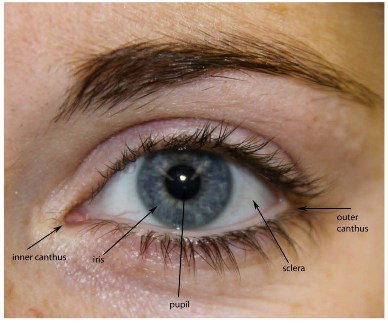
Humans typically have two eyes of equal size. The iris (colored part of the eye) surrounds a dark central pupil. This pupil normally fluctuates in size, becoming larger in dim light, and smaller in bright light. The sclera, or surface of the eyeball is normally white. The corners of the eye are called canthi. The inner canthus is closest to the nasal bridge, and the outer canthus is closest to the outer ear. The upper and lower eyelids each contain a complete row of eyelashes, and the space between the lids is called the palpebral fissure. The appearance of the palpebral fissures provides a starting place for examining the external eye.
Eye Orientation
Eye orientation is the relationship of the palpebral fissures to the remainder of the facial structures. A palpebral fissure is the physiologic name given to the separation between the upper and lower eyelids. In an adult, a palabral fissure measures about 10 mm vertically and 30 mm horizontally. Palabral fissures sometimes vary in orientation including horizontal size and vertical height. Three types of orientation can occur on the human face: horizontal, upslanting, and downslanting.
Eye Anomalies as Diagnostic Indicators of Communication Disorders
October 11, 2010
Share:
Related Courses
1
https://www.speechpathology.com/slp-ceus/course/ripple-effect-stuttering-community-based-9217
The Ripple Effect of Stuttering: A Community-Based Approach
This is Part 2 of a four-part series. The stuttering experience has a ripple effect that extends far beyond the child who stutters. Parents, teachers, peers, and others must possess both knowledge and skills to best support children who stutter. This course will highlight new clinical tools and resources to provide a community-based treatment approach for stuttering. (Part 1 - Course 9278, Part 3 - Course 9301, Part 4 - Course 9304)
auditory, textual, visual
129
USD
Subscription
Unlimited COURSE Access for $129/year
OnlineOnly
SpeechPathology.com
www.speechpathology.com
The Ripple Effect of Stuttering: A Community-Based Approach
This is Part 2 of a four-part series. The stuttering experience has a ripple effect that extends far beyond the child who stutters. Parents, teachers, peers, and others must possess both knowledge and skills to best support children who stutter. This course will highlight new clinical tools and resources to provide a community-based treatment approach for stuttering. (Part 1 - Course 9278, Part 3 - Course 9301, Part 4 - Course 9304)
9217
Online
PT120M
The Ripple Effect of Stuttering: A Community-Based Approach
Presented by Craig Coleman, MA, CCC-SLP, BCS-F, ASHA Fellow, Mary Weidner, PhD, CCC-SLP
Course: #9217Level: Intermediate2 Hours
ASHA/0.2 Intermediate, Professional; Calif SLPAB/2.0; IACET/0.2; Kansas LTS-S1370/2.0; SAC/2.0
This is Part 2 of a four-part series. The stuttering experience has a ripple effect that extends far beyond the child who stutters. Parents, teachers, peers, and others must possess both knowledge and skills to best support children who stutter. This course will highlight new clinical tools and resources to provide a community-based treatment approach for stuttering. (Part 1 - Course 9278, Part 3 - Course 9301, Part 4 - Course 9304)
2
https://www.speechpathology.com/slp-ceus/course/20q-infection-control-strategies-for-9729
20Q: Infection Control Strategies for SLPs
Speech-language pathologists are expected by policy authorities to apply appropriate measures to protect patients, co-workers and themselves in clinical situations that may expose individuals to infectious microbes. This article provides practical guidelines for implementing infection control principles within the context of the COVID-19 pandemic, including discussion of personal protective equipment (PPE) and disinfecting and cleaning products.
textual, visual
129
USD
Subscription
Unlimited COURSE Access for $129/year
OnlineOnly
SpeechPathology.com
www.speechpathology.com
20Q: Infection Control Strategies for SLPs
Speech-language pathologists are expected by policy authorities to apply appropriate measures to protect patients, co-workers and themselves in clinical situations that may expose individuals to infectious microbes. This article provides practical guidelines for implementing infection control principles within the context of the COVID-19 pandemic, including discussion of personal protective equipment (PPE) and disinfecting and cleaning products.
9729
Online
PT60M
20Q: Infection Control Strategies for SLPs
Presented by A.U. Bankaitis Smith, PhD
Course: #9729Level: Intermediate1 Hour
ASHA/0.1 Intermediate, Professional; Calif SLPAB/1.0; IACET/0.1; Kansas LTS-S1370/1.0; SAC/1.0
Speech-language pathologists are expected by policy authorities to apply appropriate measures to protect patients, co-workers and themselves in clinical situations that may expose individuals to infectious microbes. This article provides practical guidelines for implementing infection control principles within the context of the COVID-19 pandemic, including discussion of personal protective equipment (PPE) and disinfecting and cleaning products.
3
https://www.speechpathology.com/slp-ceus/course/thickened-liquids-in-clinical-practice-10497
Thickened Liquids in Clinical Practice: The Plot “Thickens”
Clinicians who utilize thickened liquids in their clinical practice are aware of their benefits, but what about the risks and contraindications? Advantages and disadvantages of thickened liquids are reviewed in this course with a focus on clinical outcomes, including impacts on medication administration, lung health, and hydration. Product types are evaluated to facilitate appropriate choices for individual clients.
auditory, textual, visual
129
USD
Subscription
Unlimited COURSE Access for $129/year
OnlineOnly
SpeechPathology.com
www.speechpathology.com
Thickened Liquids in Clinical Practice: The Plot “Thickens”
Clinicians who utilize thickened liquids in their clinical practice are aware of their benefits, but what about the risks and contraindications? Advantages and disadvantages of thickened liquids are reviewed in this course with a focus on clinical outcomes, including impacts on medication administration, lung health, and hydration. Product types are evaluated to facilitate appropriate choices for individual clients.
10497
Online
PT60M
Thickened Liquids in Clinical Practice: The Plot “Thickens”
Presented by Angela Mansolillo, MA, CCC-SLP, BCS-S
Course: #10497Level: Intermediate1 Hour
ASHA/0.1 Intermediate, Professional; Calif SLPAB/1.0; IACET/0.1; Kansas LTS-S1370/1.0; SAC/1.0
Clinicians who utilize thickened liquids in their clinical practice are aware of their benefits, but what about the risks and contraindications? Advantages and disadvantages of thickened liquids are reviewed in this course with a focus on clinical outcomes, including impacts on medication administration, lung health, and hydration. Product types are evaluated to facilitate appropriate choices for individual clients.
4
https://www.speechpathology.com/slp-ceus/course/slp-in-nicu-overview-11267
SLP in the NICU: An Overview
This course provides an introductory overview of Speech-Language Pathology services in the Neonatal Intensive Care Unit (NICU), including the unique environment, the SLP’s role, and key components of neonatal care. Topics include cue-based and supportive feeding strategies, instrumental assessments, and approaches for empowering and supporting parents and caregivers.
auditory, textual, visual
129
USD
Subscription
Unlimited COURSE Access for $129/year
OnlineOnly
SpeechPathology.com
www.speechpathology.com
SLP in the NICU: An Overview
This course provides an introductory overview of Speech-Language Pathology services in the Neonatal Intensive Care Unit (NICU), including the unique environment, the SLP’s role, and key components of neonatal care. Topics include cue-based and supportive feeding strategies, instrumental assessments, and approaches for empowering and supporting parents and caregivers.
11267
Online
PT60M
SLP in the NICU: An Overview
Presented by Anna Manilla, MS, CCC-SLP, CLC
Course: #11267Level: Introductory1 Hour
ASHA/0.1 Introductory, Professional; Calif SLPAB/1.0; IACET/0.1; IL EITP/1.0; Kansas LTS-S1370/1.0; SAC/1.0
This course provides an introductory overview of Speech-Language Pathology services in the Neonatal Intensive Care Unit (NICU), including the unique environment, the SLP’s role, and key components of neonatal care. Topics include cue-based and supportive feeding strategies, instrumental assessments, and approaches for empowering and supporting parents and caregivers.
5
https://www.speechpathology.com/slp-ceus/course/dysphagia-in-neurodegenerative-disease-9732
Dysphagia in Neurodegenerative Disease
Dysphagia is common in individuals with amyotrophic lateral sclerosis (ALS) and Parkinson’s disease. This course discusses the underlying pathophysiology and appropriate treatment programs for each disease, as well as use of alternate methods of nutrition/hydration.
auditory, textual, visual
129
USD
Subscription
Unlimited COURSE Access for $129/year
OnlineOnly
SpeechPathology.com
www.speechpathology.com
Dysphagia in Neurodegenerative Disease
Dysphagia is common in individuals with amyotrophic lateral sclerosis (ALS) and Parkinson’s disease. This course discusses the underlying pathophysiology and appropriate treatment programs for each disease, as well as use of alternate methods of nutrition/hydration.
9732
Online
PT60M
Dysphagia in Neurodegenerative Disease
Presented by Debra M. Suiter, PhD, CCC-SLP, BCS-S
Course: #9732Level: Intermediate1 Hour
ASHA/0.1 Intermediate, Professional; Calif SLPAB/1.0; IACET/0.1; Kansas LTS-S1370/1.0; SAC/1.0
Dysphagia is common in individuals with amyotrophic lateral sclerosis (ALS) and Parkinson’s disease. This course discusses the underlying pathophysiology and appropriate treatment programs for each disease, as well as use of alternate methods of nutrition/hydration.