
This article is a written transcript of the course, “Best Practices in Assessment & Evaluation in Supervision”, presented by Carol Dudding, Ph.D. on June 6, 2011.
>> Amy Hansen: Good afternoon, everyone, and welcome to this week's virtual conference on topics in supervision. We're very honored to have Carol Dudding joining us as our guest editor this week as well as our presenter for today. So our Expert e-Seminar today is entitled, “Best Practices in Assessment and Evaluation in Supervision”. At this time I am very pleased to introduce Carol Dudding. Carol Dudding is Director of Clinical Education and Assistant Professor at James Madison University. She is also the Principal Investigator and Program Director of an online Master's Degree program in speech-language pathology and a project exploring the use of telepractice in the public schools. Carol has published and presented internationally and nationally on the topics of clinical education and supervision, telepractice and e-supervision and online learning. So welcome Carol and thank you so much for sharing your expertise with us today.
[Applause]
>> Carol: Well, thank you. And welcome to everyone. I appreciate you spending your time with me this afternoon and today as Amy mentioned we're going to be talking about Best Practices in Assessment and Evaluation in Supervision. So there is a lot to go over and hopefully we'll make the best use of the time that we have together. And my assumption here is that many, if not all of you, have some experience in supervision because this is meant to be more of an intermediate course. If you have any questions or comments please feel free to use the Q and A box that Amy discussed. All right. Let's move on then to get to the content.
Roles of Supervisor
All right. I would like for you again to think about your role of supervisor.
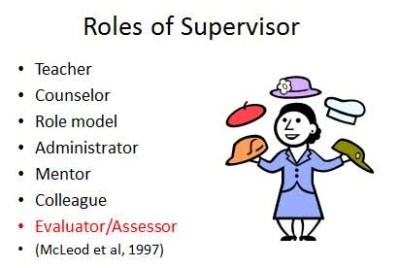
I love this picture here because it does remind us that when we take on the role of supervisor, no matter who it is we're supervising, we indeed wear many hats. The role that comes to mind most frequently is that of a teacher. We feel that we as professionals are somehow teaching and carrying on the information that we've learned through our lifelong learning as professionals and teaching other people that information. But then again, those of us who have been supervisors are well aware that we're also counselors; sometimes surprisingly to the degree that we have to do that but we often find ourselves being counselors in one form or the other. Like it or not, realizing we are role models, as well, for our supervisees. I encourage you to think back through your clinical training, who your supervisors were in your early years and how, indeed, they did serve as a role model for you.
Some of us may be finding ourselves in the role of administrator and that is where our assessment and evaluation responsibilities come into play. Hopefully many of you have had the opportunity to serve as a mentor and/or be mentored by someone else. It is a very rewarding relationship that we enjoy as part of supervision. And sometimes as the role of supervisor we're just being a colleague or there is an area and we've been asked to help provide some supervision in a particular situation or circumstance. And then the one I have here - and the one that we're going to be talking about today - is that of an evaluator or assessor as being one of the roles of supervision. And Amy mentioned in my bio that I'm at James Madison University in the clinic and so I spend much of my recent years supervising graduate clinicians and working with off-campus supervisors on that. Prior to this life I worked in healthcare for a number of years and I found I was an evaluator of co-workers and other employees both within the SLP and other professionals. So I found myself in that role and I'll have to be honest with you folks that this particular role of supervisor is not always one that I enjoy and/or relish and so some of you might have that similar feeling and hopefully today some of the information that I can share with you will help make the process at least more comfortable for you and the people that you are evaluating and supervising. And again I'm going to keep plugging this week's worth of SpeechPathology.com events.